
Business / 02 Playbook
Carbon Credit
Procurement Playbook
Run credit procurement yourself, from zero.
A textbook and toolkit for reaching the point where your own team can judge and execute procurement without outside dependence. 28 chapters, 140 sections. Read it through and you can stand on your own as a procurement lead.
View the playbook →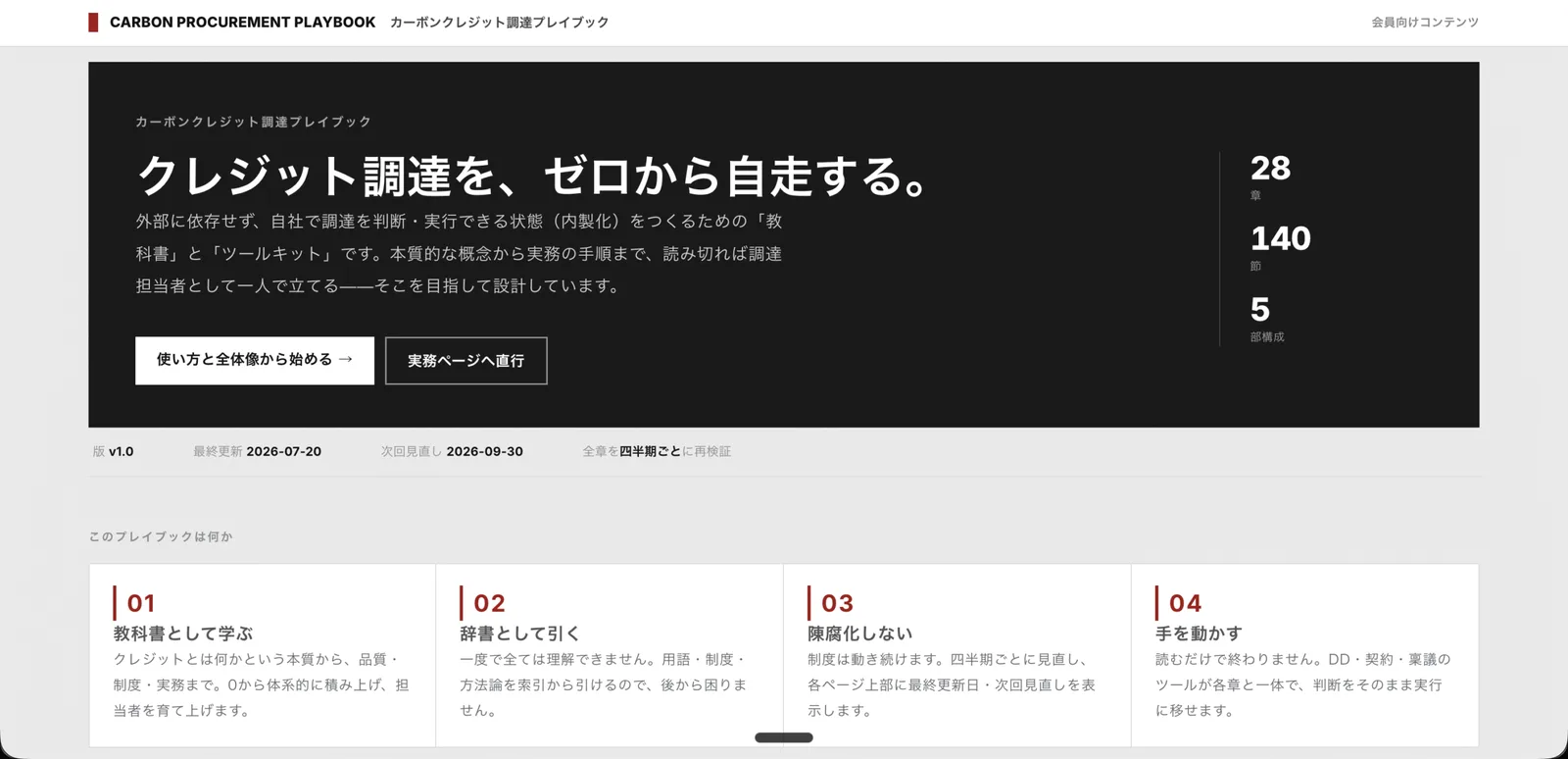
How to Use
Four ways to use it
Learn it as a textbook
From the essentials through to the practice of systems, quality, and procurement — in order. Written to assume no prior knowledge, it is the first book to read for a view of the whole field.
Look things up as a dictionary
A glossary, a reverse-lookup reference of schemes and standards, catalogues of methodologies and project types, and an FAQ — so you can pull up just the part you need, when you need it.
It does not go stale
Every chapter is re-verified quarterly. The last-updated date and the next review are shown at the top of each page.
Put it to work
With toolkits such as scoring sheets and checklists, you can carry what you have read straight into your own practice.
Contents
Structure
After an opening "Start here" (about five minutes) and "How to use this playbook and the big picture," it is organised in five parts.
Grasping the essentials
- Understanding what a credit really is
- Knowing the history and current state of the market
- Why companies buy credits
The principles of quality and mechanism
- Understanding the principles of quality (additionality, permanence, double counting, and more)
- Surveying the types of credit (nature-based / removal technologies)
- Knowing how credits come into being
Reading systems and rules
- Holding a map of the schemes
- Understanding the compliance markets (ETS, CBAM, CORSIA)
- Understanding the voluntary market and certification standards
- Knowing the gatekeepers of quality and claims (ICVCM/VCMI/SBTi)
- Understanding Article 6 of the Paris Agreement
- Knowing Japan's systems (J-Credit/GX-ETS/JCM)
Carrying out procurement
- Planning procurement (strategy, portfolio, internal carbon price)
- Running the procurement process
- Accessing the market (bilateral / exchanges / marketplaces)
- Judging quality (due diligence)
- Contracting
- Reading prices
- Managing risk
- Preparing for accounting, tax and legal
- Getting it through the company (internal approval and governance)
- Managing after procurement (retirement, disclosure, making claims)
Outlook, and looking things up (dictionary)
- Looking ahead at the market (stronger regulation, Article 6 in operation, the shift to removals)
- Glossary
- Reference to schemes and standards (reverse lookup)
- Catalogue of methodologies and project types
- Frequently asked questions (FAQ)
Toolkit
Toolkit
Members-only Excel tools that work together with the chapters.
- 01
DD scoring sheet
Scores quality, additionality, and risk against defined criteria. Works together with the chapter on judging quality.
- 02
Contract clause checklist
Checks every clause that needs confirming, ranked by importance, without gaps. Works together with the chapter on contracting.
- 03
Internal approval template and Q&A
Assembles an approval request and anticipated Q&A from templates. Works together with the chapter on getting it through the company.
For Whom
Who it is for
Procurement and sustainability leads, of course, but also corporate planning and business development, credit suppliers, and people in finance, media, and research. It is written to assume no prior knowledge.
What it aims for is a state in which you can decide, on your own, where the right landing point lies for your company.
Notes
Availability and notes
- Availability
- A benefit of CDR PRO membership. The same membership as the CDR PRO databases gives you every chapter (the first seven days are free).
- Updates
- Every chapter is re-verified quarterly to keep pace with regulatory change.
- Distribution
- Provided as web pages for members. It is not freely redistributed as PDF or the like.
- Please note
- This playbook is neither an educational service nor a substitute for consulting. It does not replace final legal, tax, or accounting judgement.
Related pages: See inside CDR PRO ・ FAQ
View the playbook →